If you'd like to buy some of 2014's crop of honey. You can contact me via the Heights Honey Facebook page: https://www.facebook.com/heightshoneybees.
Thanks!
Justin
Tuesday, October 7, 2014


Tuesday, July 3, 2012
Two Queens in the Big Daddy, Hives Everywhere!
When I first started reading about beekeeping, I kept reading about how CCD and all these bee diseases are killing off bees. The statistics were something like 30% of the hives in the US would die off each year. Well, it doesn't take a lot of smarts to realize that too many years of that and pretty soon there's no bees left. I've come face to face with how beekeepers have been "mostly" able to deal with this. You see, I started last year with one hive. As of right now, I have three hives and I did not buy more bees. If we're getting technical there are 4 hives in my backyard, but one of them is my friends and he's keeping it in my backyard just for this season (while he builds a fence on his property to hide the bees from renters). The key is that beekeepers make more hives each year by splitting hives or catching swarms. Now, I already mentioned that my Big Daddy hive swarmed earlier this year (even though I had tried to split it). So I had split the one hive and that gave me hive #2. Well, for a while there after the split and the swarm, I noticed that the Big Daddy hive was queenless. So I bought a queen from a local beekeeper. I put the queen in and then I put on a queen excluder. Now, previously I wasn't a big fan of queen excluders. They make it harder for the bees to get up into the supers in order to lay down the nectar and make honey. However, I was getting the queen up in the supers laying eggs. Now, I'd like to keep my supers just for honey and have the deeps be for the eggs and brood. This is where the queen excluder came in. I figured if I could keep the queen out of the supers for long enough, the bees would be able to lay down nectar and the brood in the supers would hatch out and then things would end up being fine. Queen excluder goes in: fwoosh, chunk. Supers placed back on top. Then a week later, I'm inspecting again, and what do you know, I'm still seeing eggs in my supers! So now, I've got a queen below the excluder and a queen above the excluder! My bees were making me angry. Well, at the time, we had thought that my friend's hive was queenless. So we were able to catch the queen above the excluder (marked) her and placed her in a queen cage. However, upon moving her over to check out his hive and introduce the queen cage. I saw eggs! We then found his queen, and so we marked her.
Instead of killing the queen above the excluder (now in the queen cage). We took the brood in the supers, the queen, and a small number of bees and placed them in a nuc. Thus was born hive #3. This nuc will remain a nuc and will be an insurance policy (queen replacement) for hive #1 and #2 if necessary. So, this splitting of the current hive of bees and providing or allowing the bees to raise a queen is how the US bee population has been able to survive so many years of 20-30% losses.
Instead of killing the queen above the excluder (now in the queen cage). We took the brood in the supers, the queen, and a small number of bees and placed them in a nuc. Thus was born hive #3. This nuc will remain a nuc and will be an insurance policy (queen replacement) for hive #1 and #2 if necessary. So, this splitting of the current hive of bees and providing or allowing the bees to raise a queen is how the US bee population has been able to survive so many years of 20-30% losses.
Thursday, June 7, 2012
My Self-Designed Honey Label
So, I sat down to update this blog and add some pictures of what I've done with the bees so far this spring, and I got sidetracked by designing a label for my honey. I must say, I feel that it turned out very well. I didn't really find anything to inspire me. I started with a close up picture that I'd taken of a worker bee on the stones on the ground by my beehives. I then used Adobe Photoshop Elements to design the label. I cropped the picture, applied the Ink Outlines Filter and adjusted the levels. I then chose a font, and filled the font with a matched color from the bee. I used a hexagon clipping mask to further clip the picture to the shape of a honeycomb. I then looked up the requirements for honey labels from the National Honey Board (www.honey.com). The rest was adding text drop shadows and stroke outlines.
Let me know what you think!

Let me know what you think!

Wednesday, May 30, 2012
Cleveland Swarm Removal: How to Remove a Bee Swarm
Remember honeybees are at their most gentle when they are in a swarm. They are only there temporarily until they are able to find a new home. If you live in the Cleveland area, give me a call and I can come collect the honeybee swarm. When you call please give me the following information:
-How long has the swarm been there?
-How large is the swarm? Basketball size? Softball size?
-Are they honeybees?
-Have they been sprayed with an insecticide? (bad)
-Where is the swarm (address--in a tree, side of a house, etc.) and how high?
Thanks
Justin
801.783.9256
-How long has the swarm been there?
-How large is the swarm? Basketball size? Softball size?
-Are they honeybees?
-Have they been sprayed with an insecticide? (bad)
-Where is the swarm (address--in a tree, side of a house, etc.) and how high?
Thanks
Justin
801.783.9256
Summer means Swarms!
So my bees swarmed on May 15th this year. Even though I split the hive, I didn't have enough drawn out deep frames so, the frames that I put back in were just foundation. This didn't help with the space issue and so my bees swarmed. I got a call around lunch time from my wife asking me if I had time to come home because the bees were buzzing around like crazy and were really loud. I knew right then and there that they were swarming. So, I told her to try to watch to see where they would land. Unfortunately, the buggers landed super high up in a tree in my yard. I'm talking 60-100 feet up. There was no way that I would be able to reach those bees. So I've decided that I've got to set up a bait hive a bit lower in the trees in order to help catch future swarms. I think there was a large swarm and a small after swarm. They swarmed on a Tuesday. I kept checking to see how long it would take the swarm to move on. They were still there Wednesday and that Wednesday night it got pretty cold. I thought for sure that I'd find dead bees below where the swarm had been hanging out, but nope. They were fine. However, they didn't take off for wherever it was that they found for their new home until sometime late Saturday or early Sunday morning. This either means that 1) it was hard to find a decent place near where I live or 2) there were multiple competing options that may have interested the swarm and so it took a bit longer to reach a consensus on which spot to ultimately choose. I'm reading Honeybee Democracy and so it was cool to have a swarm to be able to reference to.
I've also been receiving some calls for collecting swarms. So if you live in Cleveland, Cleveland Heights, Shaker Heights, University Heights, Beachwood, or the surrounding area and you see a swarm of bees and would like someone to remove it for you without killing the bees give me a call: Justin: 801.783.9256 honeybee swarm removal. I even built a swarm bucket with a 10 ft pole to help with reaching high swarms. It still wouldn't have reached my super high one, but with a ladder and the swarm bucket I could get some high ones. I bet I'll eventually build a bee-vac but that's for another year. Unfortunately, every time I've gone out the swarm has already left or the swarm has left before I've been able to get home from work. None of them waited it out as long as mine did, perhaps because mine was so high up in the trees, they felt like they could take their time. The good thing is that I still have plenty of bees in my main hive. However, the swarm left that main colony queenless. When I inspected the bees following the swarm, the hive was incredibly nervous and quick to fly and angry (many stingers in the gloves). So I had my wife pick up an Italian queen from a beekeeper in a nearby city. I got a decent price: $20. I haven't checked since I requeened, but just from the entrance behavior of the bees, I'm fairly confident that she took. I've got a queen excluder on right now with an Imrie shim above it. The Imrie shim is supposed to give the bees an upper entrance to the honey supers. I'm thinking of adding another one as well. I'm excited to see how the honey is going. I'm anticipating that the three supers that I have on now should be moving along fairly well with the capping of the honey.
I've been feeding the hive that I split. The cool thing was that when I had gone through after the split and sought to remove swarm cells in the large hive, I kept killing the swarm cells. Well, one of the last ones I opened just to see how far along the queen was and the queen literally crawled out of the cell. She started racing along my glove and so I quickly moved her over to the split that I had made the day before and placed her in there. When I later inspected, I saw a beautiful queen laying. She must have taken! Gone out and mated with nearby drones and come back to start hive number 2. I later moved them from the nuc and they are now in a 10 frame Langstroth in a single deep. My plan is to keep 2 hives and a nuc as an emergency queen raising machine. I'm hoping to catch a swarm for the nuc sometime this summer. Hopefully someone calls again.
Monday, April 30, 2012
Spring Hive

Thursday, April 12, 2012
Safe when you see the Lion's Tooth
Ever wonder why the small yellow "weeds", actually a wildflower, are called dandelions? Apparently the word is French, dent-de-lion meaning lion's tooth. This doesn't refer to the flower, but rather to the leaves. If you look at the leaves of the dandelion one can see the saber tooth shape of a lion's tooth. So, I've heard that beekeepers need no longer worry about their bees starving once they see dandelion's blooming. Dandelions have been blooming for a couple weeks here now, thanks to the uncharacteristically warm weeks in March (in the 80s). Things have cooled down quite a bit, recently though. Apparently dandelions are source of both nectar and pollen for bees. You won't ever see dandelion honey though, because mostly this nectar/pollen goes toward rearing of young bees and because it's one of the first spring flowers that bees are able to collect (temperatures have warmed enough), there isn't a lot of extra to go around (for the beekeeper to steal). With the cooler weather, I have worried some that it has been too cold for the bees to fly and I hope that the trees that are blooming are still providing enough nectar, and there are enough days with flyable weather (at least in the 50s).
Funny story, last fall I took some pictures and video (will need to post here) of my daughter (5 yrs old) playing with a drone. When the hive kicked out the drones, I grabbed one and took it inside to let my kids play with it. For some reason it didn't fly around much, must have been nearing it's end, but that was best. This enabled my kids to be able to play with it as it crawled around, quickly buzzed off somewhere nearby and landed, only to be picked up again. My daughter thought it was great. I let her know that boy bees can't sting. Well, the other day my wife called me and told me that my daughter had been stung. Initially, I was somewhat concerned (first time any of my kids had been stung). When I got home, I asked my daughter what had happened. Evidently, she was outside and had found a bee. She tried to pick it up and it stung her. When I asked her how she had been stung, she said, "I found a bee and tried to pick it up, but it was a girl." Yup, I let her know that there are a lot more girl bees than boy bees, and it's best for her to just assume they are all girls and let Dad find the boy bees. I also let her know that the girl bee stung her because it was scared of being picked up, and if she lets the bees mind their own business, the bees will do the same with their stingers. I think my daughter handled it pretty well though, she knew exactly why she had been stung--she'd tried to pick up a GIRL bee, if only it had been a BOY. :)
 |
| Dandelion at base of my hive. You can see the hive stand above the bricks. |
Monday, April 9, 2012
Brood in the Supers
As soon as I saw that the trees here in Ohio were blooming, I decided I should put my honey supers on. I want to make sure that I catch all of the honey flow that I can. Everywhere that I've read, it is important to have enough place to put nectar so that you can end up getting more honey. This is because bees will place down nectar and then they have to evaporate it down (kind of like with maple sap to make maple syrup). Well, if there isn't enough room to place down the watery-nectar, you won't get as much honey.
So here's how I am hoping to get more honey this year:
1) I'm putting 9 frames instead of 10 in my honey supers. Now, this is somewhat counter-intuitive. Less frames in the honey supers can actually give you more honey (at least 9 vs. 10). This is because the bees will draw out the wax on the frames to be thicker. You'll then get more honey per frame than you would with 10 frames. Evidently this also makes it easier to uncap.
2) I have my honey supers already drawn with wax. The honey supers are already drawn out, this means that the honey flow will go entirely for making honey and not for making wax. This should equate to more honey.
I decided after this last inspection to rotate the hive bodies. The bottom hive body had bees and a small amount of brood, but not a lot, and I'd rather them utilize that hive body than be tempted to adulterate my honey supers. The presence of brood in 2 of my honey supers (the shallow that I left on over the winter, and the medium honey super) made me go out and buy a queen excluder. As soon as that comes, I am excluding my queen from those honey supers. To make it easier for the bees to get in to the supers, though, I'll put in an Imirie shim. This will create an upper entrance for returning foragers to immediately go up and enter the honey supers. My hope is that the queen excluder will allow the current brood to hatch, and then the bees will refill those cells with honey. Once that natural honey barrier is formed, I should be able to remove the queen excluder.
During the first inspection of the year, I flipped over the inner cover. During spring/summer/fall, the inner cover notch faces up (no upper entrance). At this point, the bees had been using that upper entrance solely. The bottom entrance was open, but no one used it. So as soon, as I closed that up. There were a bunch of confused bees at the end of that day and throughout the next day. The bees would crowd that upper entrance area, but then little by little a couple bees were seen down at the bottom entrance fanning their Nasonov glands and releasing the hive scent, essentially signaling, "Here it is! I found it!" Well, then I saw a line of bees walking down the face of the hive from top towards the bottom entrance. They would then enter. It probably took 20 minutes or so for the busy crowd of bees to re-orient to the open entrance at the bottom of the hive. It was very cool to watch the bees adapt this way and learn about the new hive entrance.
So here's how I am hoping to get more honey this year:
1) I'm putting 9 frames instead of 10 in my honey supers. Now, this is somewhat counter-intuitive. Less frames in the honey supers can actually give you more honey (at least 9 vs. 10). This is because the bees will draw out the wax on the frames to be thicker. You'll then get more honey per frame than you would with 10 frames. Evidently this also makes it easier to uncap.
2) I have my honey supers already drawn with wax. The honey supers are already drawn out, this means that the honey flow will go entirely for making honey and not for making wax. This should equate to more honey.
I decided after this last inspection to rotate the hive bodies. The bottom hive body had bees and a small amount of brood, but not a lot, and I'd rather them utilize that hive body than be tempted to adulterate my honey supers. The presence of brood in 2 of my honey supers (the shallow that I left on over the winter, and the medium honey super) made me go out and buy a queen excluder. As soon as that comes, I am excluding my queen from those honey supers. To make it easier for the bees to get in to the supers, though, I'll put in an Imirie shim. This will create an upper entrance for returning foragers to immediately go up and enter the honey supers. My hope is that the queen excluder will allow the current brood to hatch, and then the bees will refill those cells with honey. Once that natural honey barrier is formed, I should be able to remove the queen excluder.
 |
| Honeybee on peppermint flower. Yum! Peppermint honey?! |
Wednesday, March 21, 2012
They Live! Early Spring...Bees Love it!
I must say that the bees have got to be just as excited as I am that spring came early this year. I cannot believe it: the last couple days have been approaching 80 degrees and it's mid-March in Cleveland. I just barely planted my seeds indoors and it appears that I could have planted them outdoors! I need to plant outdoors soon (spinach, lettuce, onions, etc.)
I did start feeding my bees in mid February. It had been a relatively warm winter and I was somewhat concerned that they would be running out (considering that I saw bees at the top of the hive). I'd say that I fed about 20 lbs. of sugar up until a week or so ago. There is now enough blooming that I feel the bees should be fine. I put two medium supers on top of my 2 deeps and 1 shallow that I kept on in the winter. Unfortunately, there are some eggs in that shallow (tempting me to buy a queen excluder to keep the queen from re-laying in my honey super. The bottom deep was basically empty. I didn't rotate the hive bodies then. I still haven't rotated the hive bodies. I'm not sure yet whether I will. The bees by the end of the winter were using the upper entrance, and after my inspection, I flipped over the inner cover and that upper entrance went away. The next day the bees were busy re-orienting to the bottom entrance. Bees were climbing down the face of the hive after they had tried flying in to the top entrance only to find that there was a bucket of syrup blocking the inner cover hole. Bees were lined up on the bottom of the entrance fanning and exposing their Nasonov glands to give off the hive scent. It probably took several hours to get all the foragers re-oriented to the bottom entrance, but now, they are all used to it like normal. My hope is that by just having to travel through that bottom deep that the bees and the queen will move down to inhabit and use that space. I'd be somewhat irked if the queen just keeps moving up and starts laying in my medium honey supers.
I must say that I am pleased that my bees made it through the winter. I didn't do a lot to baby them through the winter. I ended up draping a tarp over the hive just to keep the wind from attacking the hive too much and to slightly help the temperature stay warmer. I did put some insulation under the top cover (newspaper and insulation) in hopes to reduce condensation within the hive.
I had previously planned on using some Imrie shims this year. I haven't put them together yet, but we'll see if they end up helping. I'm excited to start working with the bees again this year. I plan on doing a split later in the spring once I get the Cordovan queen that I ordered. Then I'll start up hive number two. I'm excited for that as well. Oh, and I think I inspired a friend from my church to start keeping bees. Love it! Bees are incredibly awesome. Now if only I could find a place for some chickens. . . . :)
I must apologize, however, as I did not take any pictures of the hive throughout the winter. In hindsight, it would have been cool to share some seasonal progression on here. I'll have to remember that for next time. I did start a beekeeping project over the winter, though it didn't get finished or as far as I would have hoped. However, technically, I had thought that I would have a month or two of winter still. So, my observation hive is not yet complete. In fact, it's probably closer to just started than just finished. Though I am also excited about that. I can see my kids absolutely loving that! Happy early spring and best wishes to the bees and the blooms! Let's hope this weather holds and that a frost doesn't nip spring in the bud....
I did start feeding my bees in mid February. It had been a relatively warm winter and I was somewhat concerned that they would be running out (considering that I saw bees at the top of the hive). I'd say that I fed about 20 lbs. of sugar up until a week or so ago. There is now enough blooming that I feel the bees should be fine. I put two medium supers on top of my 2 deeps and 1 shallow that I kept on in the winter. Unfortunately, there are some eggs in that shallow (tempting me to buy a queen excluder to keep the queen from re-laying in my honey super. The bottom deep was basically empty. I didn't rotate the hive bodies then. I still haven't rotated the hive bodies. I'm not sure yet whether I will. The bees by the end of the winter were using the upper entrance, and after my inspection, I flipped over the inner cover and that upper entrance went away. The next day the bees were busy re-orienting to the bottom entrance. Bees were climbing down the face of the hive after they had tried flying in to the top entrance only to find that there was a bucket of syrup blocking the inner cover hole. Bees were lined up on the bottom of the entrance fanning and exposing their Nasonov glands to give off the hive scent. It probably took several hours to get all the foragers re-oriented to the bottom entrance, but now, they are all used to it like normal. My hope is that by just having to travel through that bottom deep that the bees and the queen will move down to inhabit and use that space. I'd be somewhat irked if the queen just keeps moving up and starts laying in my medium honey supers.
I must say that I am pleased that my bees made it through the winter. I didn't do a lot to baby them through the winter. I ended up draping a tarp over the hive just to keep the wind from attacking the hive too much and to slightly help the temperature stay warmer. I did put some insulation under the top cover (newspaper and insulation) in hopes to reduce condensation within the hive.
I had previously planned on using some Imrie shims this year. I haven't put them together yet, but we'll see if they end up helping. I'm excited to start working with the bees again this year. I plan on doing a split later in the spring once I get the Cordovan queen that I ordered. Then I'll start up hive number two. I'm excited for that as well. Oh, and I think I inspired a friend from my church to start keeping bees. Love it! Bees are incredibly awesome. Now if only I could find a place for some chickens. . . . :)
I must apologize, however, as I did not take any pictures of the hive throughout the winter. In hindsight, it would have been cool to share some seasonal progression on here. I'll have to remember that for next time. I did start a beekeeping project over the winter, though it didn't get finished or as far as I would have hoped. However, technically, I had thought that I would have a month or two of winter still. So, my observation hive is not yet complete. In fact, it's probably closer to just started than just finished. Though I am also excited about that. I can see my kids absolutely loving that! Happy early spring and best wishes to the bees and the blooms! Let's hope this weather holds and that a frost doesn't nip spring in the bud....
Wednesday, October 5, 2011
Liquid Gold: the sweetest thing!
On September 10th I harvested the first round of honey from my own backyard! I harvested one medium super. This was the medium super that had been filled with honey first and so was from mostly late spring/early summer honey. I extracted the honey with a cold uncapping knife and used a hand crank tangential extractor to spin out the honey from the frames. Nearly all the honey in this medium super was capped. Maybe one part of one frame was not capped, but the honey was cured. This means that the nectar did not drip out when turned upside down, so the risk of the honey fermenting is low. I do not yet have a refractometer to test the amount of water in my honey. Anything over 18% apparently can ferment and go bad. Generally the bees will cap the honey once it has reached below this magic number. Of course, I assume that if the cell isn't filled high enough, the cell won't be capped.


I extracted my honey in the basement and used a fume board to scare the bees down out of the super. I used Natural Honey Harvester spray and it worked great. I had maybe 10 bees in the basement. In extracting, I had to uncap both sides of the frame and then put up to 4 frames in my extractor and then spun out the honey on one side. I then switched the frames to the other side and spun out the honey on the other side. I then opened the honey gate at the bottom of the extractor and had the honey run through a coarse filter into a bucket with a honey gate on it so that I could bottle the honey. I had a space heater set up in the basement to keep things warm so that the honey flowed well. While extracting I listened to the Cleveland Indians, who unfortunately lost to the White Sox during that game.


The setup.
A frame of capped honey. Isn't it beautiful?


Cutting off the cappings.


So sweet, so good. Lick it up!

Liquid gold from the honey gate.


Honey with the cappings wax.

Even the kids enjoyed the extracting process. This is my daughter with some of her friends.

So in all, I extracted 33 pounds of honey from that one super. I filled 24 of that in these cool looking queenline glass jars. I've given a bunch of them away. Unfortunately, haven't sold any. But I think, perhaps if I use the excess of my honey as a source of giving and service, the hive will be blessed and will do better than were I to use the honey for selfish means. Who knows. Of course, I can't rely on that belief and neglect my hive. Faith without works, you know. . . dead. Anyway, my wife and I gave two of them (the 1 lb. glass jars) away to our neighbors. I found a scripture in the Bible that says, "How sweet are thy words unto my taste! Yea, sweeter than HONEY to my mouth!" -Psalms 119:103. I tried to use the giving out of the honey as an opportunity to share what has been sweet to us: the gospel. The card is a mormon.org pass-along card with my profile, some fresh baked bread, and a Book of Mormon. The sweetest things!
Thursday, September 15, 2011
Beekeeping with Dad
While on vacation this summer I had the opportunity to help my father inspect his bees. You see, it was originally my father who got me interested in beekeeping. He has a cousin in Utah that started up a neighborhood beekeeping business and so my dad was interested in getting a hive. When my dad got one, it basically made me realize that anyone can keep bees. I thought, wow, that is cool and I immediately started learning about it. From there, I was hooked. It's true in that beekeeping has this addictive nature to it. Probably because the little insects are so fascinating to watch and learn about. I used to grab a folding chair and sit off to the side of the hive entrances and just watch the bees fly in and away from the hive. It's fascinating as well as peaceful. Here are a some pictures of my dad's hives. The one on the right was always more active from the get-go. It must have had a better queen.

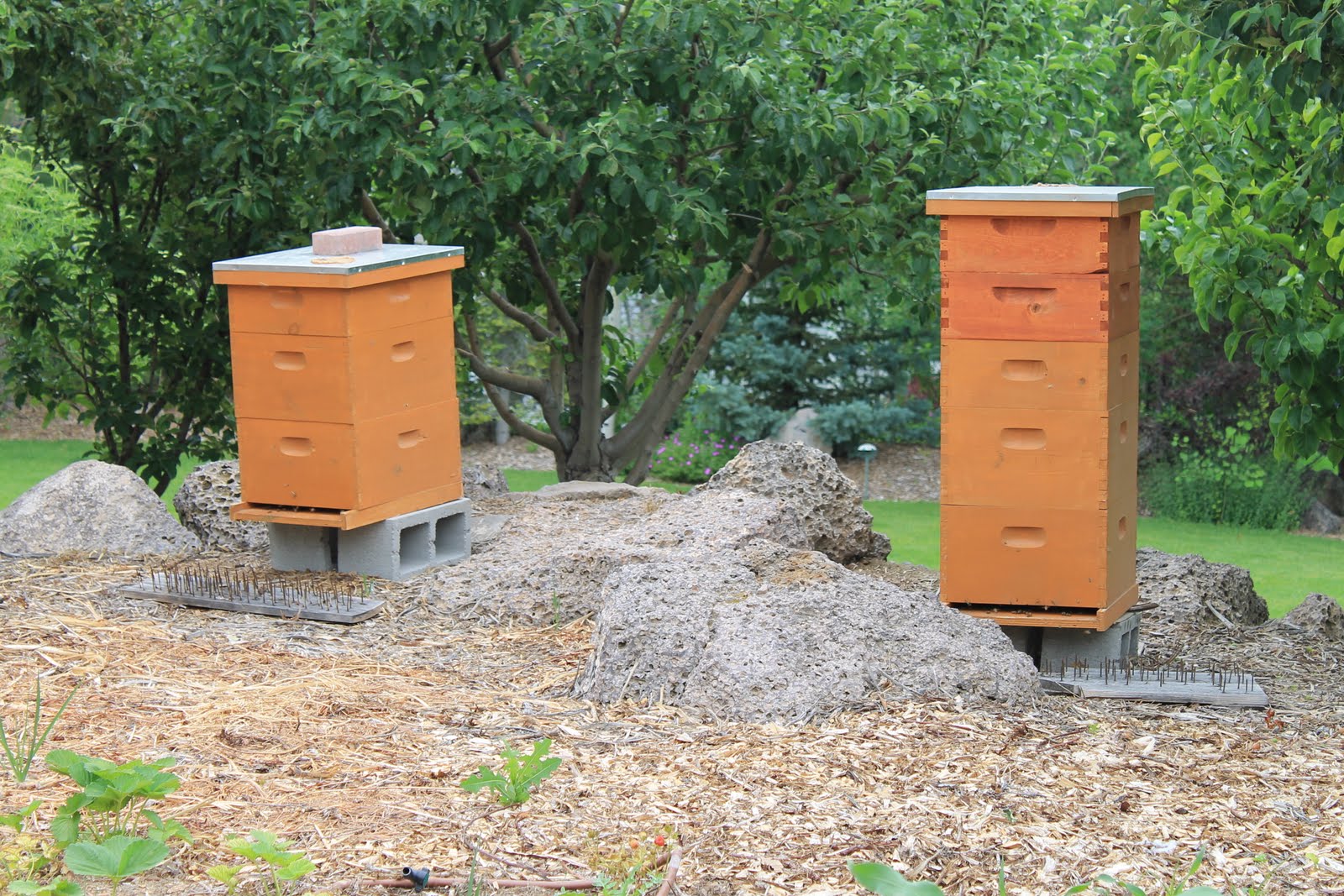
You can see the spikes of nails below the hive. These are placed there to keep skunks, raccoons, or other critters from trying to have meals consisting of insects with a sweet inside (i.e., eating bees).

The bees collecting water from the nearby lake.


My dad holding up a beautiful capped frame of honey.

My dad.

Frame rests are the best!

We brought out the umbrella so that we'd be inspecting in the shade. It helped a ton. We were sweating like crazy! That's me looking for eggs or the queen. We didn't find the queen, and I couldn't see any eggs. I only saw one egg in that entire hive and it was on the side of a cell. Most likely from a laying worker. We saw tons of drones though. Bad news. Both hives were queenless and so new replacement queens were ordered. Cost about $60. Queens aren't cheap, but they are most definitely necessary. And one could definitely argue that good queens are worth the money. I eventually would like to raise my own queens for my hives.

There's me still looking for the eggs.


Keeping bees is fun! It's even funner when you are doing it with someone. Thanks Dad for letting me help with your inspection and for getting me involved in beekeeping. You're the best.
Wednesday, August 24, 2011
White Queen & Impatiently Waiting for Honey
I've been pretty busy the past several weekends and haven't had the opportunity to inspect my bees. However, I've been prepping the "honey house" aka the unfinished basement. I know that I've got at least one full medium super of capped honey. This means that the bees have placed a layer or "capping" of wax over the honey to keep the honey from either absorbing more water or from evaporating down further. When honey is capped like this, then it is usually safe to extract. You see honey that is more than 18.6% water will ferment. The bottle of honey will go bad and the bottle can even burst. That would be a shame and a sticky mess. Bees must have a way of knowing when, generally, the honey is safe to cap and that it is sufficiently evaporated down. This fermentation risk, because honey is hygroscopic, meaning that it absorbs water from the air, is also a reason why it can be important to extract your honey quickly after removing supers and perhaps even having a de-humidifier running while extracting. Interestingly, because honey is hygroscopic, if you use honey as a substitute sweetener in baked goods, you can use less liquid in the batter and the outcome will be that the cookies or whatever you made will not dry out as fast as it would if honey was not used.
Anyway, this medium super of mine that has capped honey is likely to hold close to 30 lbs. of honey. When I last inspected I checked my second medium super and found that it too is full of honey and curing nectar. The second super's frames are capped at the top 1/3. The bottom 2/3rds is nectar that is still curing and being evaporated and is not yet capped. So, this means that the extracting weekend is being moved out to probably the second weekend in September. This is tentative and depends on the bees' progress on this super over the next week or so. I'm thinking that it should be ready by then, because when I was inspecting these frames the nectar didn't run out when the frame was upside down, and so the curing process is fairly advanced already.
I was pretty proud of myself during my last inspection, as I was able to find the queen fairly rapidly. The white marking (which stands for queens introduced in years ending in 1) was starting to come off, and so I brought along a white marking pen and a small push in queen marking cage. I didn't want to have to pick up the queen because I was wearing my beekeeping gloves and was afraid that I might squish her accidentally. I've had 3 stings on the hands this season and the swelling hurts. Perhaps this is because I didn't take any Benadryl or use any ice (which when I get stung again, I will definitely be using). So I was being somewhat cautious. Next time I will try inspecting again without the gloves. The queen kept moving throughout the marking cage and so it was still somewhat tricky to get a decent dab on her thorax; but I was able to. This should mean continued ease in finding the queen. It also meant that despite the queen cells I've found at the bottom of frames, the bees have never swarmed.
However, I have noticed that my bees crowd to one side of the hive. I don't know why the brood ended up concentrated on the side of the hive rather than in the middle. My next inspection will involve me manipulating brood frames to place the brood more centrally in the hive. I definitely don't want them hugging the side as they go in to winter.
 Good luck with your bees! Here is my hive with 3 supers (2 mediums and 1 shallow) and 2 deeps below. The bees get everything in the deeps. I'll get everything in the supers. My goals was at least 30 lbs. of honey this year. Looks like my bees will be surpassing that goal!
Anyway, this medium super of mine that has capped honey is likely to hold close to 30 lbs. of honey. When I last inspected I checked my second medium super and found that it too is full of honey and curing nectar. The second super's frames are capped at the top 1/3. The bottom 2/3rds is nectar that is still curing and being evaporated and is not yet capped. So, this means that the extracting weekend is being moved out to probably the second weekend in September. This is tentative and depends on the bees' progress on this super over the next week or so. I'm thinking that it should be ready by then, because when I was inspecting these frames the nectar didn't run out when the frame was upside down, and so the curing process is fairly advanced already.
I was pretty proud of myself during my last inspection, as I was able to find the queen fairly rapidly. The white marking (which stands for queens introduced in years ending in 1) was starting to come off, and so I brought along a white marking pen and a small push in queen marking cage. I didn't want to have to pick up the queen because I was wearing my beekeeping gloves and was afraid that I might squish her accidentally. I've had 3 stings on the hands this season and the swelling hurts. Perhaps this is because I didn't take any Benadryl or use any ice (which when I get stung again, I will definitely be using). So I was being somewhat cautious. Next time I will try inspecting again without the gloves. The queen kept moving throughout the marking cage and so it was still somewhat tricky to get a decent dab on her thorax; but I was able to. This should mean continued ease in finding the queen. It also meant that despite the queen cells I've found at the bottom of frames, the bees have never swarmed.
However, I have noticed that my bees crowd to one side of the hive. I don't know why the brood ended up concentrated on the side of the hive rather than in the middle. My next inspection will involve me manipulating brood frames to place the brood more centrally in the hive. I definitely don't want them hugging the side as they go in to winter.

Monday, July 25, 2011
Too Much Honey A Problem?!
You wouldn't think that you'd ever hear a beekeeper complain about his bees making too much honey. However, this happens. You see, beekeepers want to keep as many bees as they can so that they can get more honey from each hive. However, sometimes bees can bring in so much nectar that unless the beekeepers is able to keep up on providing more space for the bees to put that nectar/honey, the bees can make it so the queen has no more room to lay eggs. As soon as this happens, the hive is said to be "honey-bound". The bees will swarm from this hive because they've essentially outgrown it.
Perhaps because I was gone so long and unable to inspect and put on my second medium super, when I last inspected my bees a large portion of the second deep (normally for rearing brood) was full of nectar and capped honey. In my opinion my bees are pretty close to being honey bound. I did find swarm cells at the bottom of the frames and some did indeed have an egg in them. I destroyed quite a few of these cells. In the future, I may leave them. I think there is some risk in that if the bees do swarm, I want a new queen to be in the works and not have destroyed my bees' chance to save themselves from a queenless doom. When I returned from vacation, I immediately put on my second super. Just this last inspection I switched the positions of the supers so that the one that the bees have filled nearly entirely with capped honey is now on the very top and the super that still needs to have wax drawn out is now just on top of the second deep.
Now, it is the middle aged 10-20 days old, bees that are the comb building, wax drawing bees. These are also the bees that are mostly involved in the nectar processing within the hive. They are sometimes called the food-storer bees. Their job is to unload the bees that have been out foraging for nectar. A forager returns and seeks out a food storer bee to unload their nectar/pollen. If the bee is able to find a food storer bee within an average of 20 seconds, then that means that there are likely less foraging bees than food storing bees. So, if the foraging bee determines that her nectar source is energetically efficient (i.e., the sugar concentration of the nectar and the amount of available forage and distance from the hive will net more energy gained than lost) she will likely perform a waggle dance. Waggle dances are only performed by bees when they deem their nectar source to be valuable enough to merit recruitment of other bees. Part of this feedback on whether the source is indeed valuable is given via the length of time required to find a food storer bee, the other part via the bee's innate judgement of the nectar source's value. If a specific nectar source is being advertised extensively via waggle dances (which will recruit unemployed foraging bees to find the source), then more bees will quickly find that nectar source and begin to forage and bring back nectar from it. This will have a cross-inhibition effect on nectar sources that are not as valuable. Because bees foraging at a less valuable nectar source will have to spend more time looking for a food-storer bee and hence will perform less waggle dances and there will be less recruitment to that nectar source and bees will be more likely to abandon forage at that source.
Interestingly, I learned while reading Thomas D. Seeley's book The Wisdom of the Hive, that when there are not enough foragers (say at the beginning of the day -- early morning), when a returning forager enters the hive, it may go up to an inactive bee and grab hold and shake it. This seemingly "awakens" the bee and makes it much more likely to go out and forage. This seems to be a signal to recruit more bees to forage.
Another signal that bees give is called the tremble dance. This dance is different than the waggle dance though it does involve shaking. However, instead of just the abdomen shaking, the entire body and legs shake back and forth. This dance is performed when there is a sudden influx of nectar and there aren't enough food storer bees to unload foragers from profitable nectar sources. This dance is performed further into the hive where nurse bees are caring for brood. It causes inactive or brood caring bees to become food storer bees.
I tell you what bees are truly amazing. I have to agree with Lorenzo Langstroth, the inventor of the movable frame hive and Father of Modern American Beekeeping, that honeybees are a witness of a divine creator!
So, it is my hope that my second, empty, undrawn medium super will be drawn out by hard-working middle aged bees so that the nectar in the brood areas can be moved up into that super so that the queen has more room to lay her eggs. The fact that wax is energetically more expensive to produce than honey may also help relieve the overflow of nectar in my bees' brood area. In fact, it takes 6 g of sugar/honey for every 1 gram of wax produced. The bees will naturally move this nectar and honey up as that is how they store their food. Honey on top, pollen just below that, then brood. Honey and pollen on the outsides of the hive. Brood in the middle. Laying eggs is important nearly year round with bees in order to replace the die off rate of foraging bees. During the summer bees (except for the queen) may live only 4 to 6 weeks, though they'll live longer in the winter when they are inactive.
Here are some interesting notes from The Wisdom of the Hive: Social Physiology of the Honeybee:
A patch of flowers 100 square meters about half the size of a tennis court, represents less than 1/125,000 of the area enclosed by a circle with a 2 km radius (and bees can fly up to 6 km radius from the hive) yet remarkably a honey bee colony has a probability of 0.5 or higher of discovering any such flower patch located within 2 km of its hive.
An average foraging trip for a bee results in either 15 mg of pollen or resin (propolis) or 30 mg of nectar or water. Many foraging trips are performed each day.
Yearly colony wide approximately 20 kg. of pollen, 120 kg. of nectar, 100 g of propolis, and 25 liters of water are collected. During the summer bees will consume 70 kg of nectar. This leaves 50 kg of food storage that the bees amass each summer. Much of this comes during what is termed "nectar flows" periods of intense flowering by certain sources that last perhaps only a week or so perhaps shorter due to inclement weather, etc.
Next time you see a honeybee, stop and take a look at it and marvel at the work it performs! I recently read a quote that I liked, "Only God can make blood and honey."
Perhaps because I was gone so long and unable to inspect and put on my second medium super, when I last inspected my bees a large portion of the second deep (normally for rearing brood) was full of nectar and capped honey. In my opinion my bees are pretty close to being honey bound. I did find swarm cells at the bottom of the frames and some did indeed have an egg in them. I destroyed quite a few of these cells. In the future, I may leave them. I think there is some risk in that if the bees do swarm, I want a new queen to be in the works and not have destroyed my bees' chance to save themselves from a queenless doom. When I returned from vacation, I immediately put on my second super. Just this last inspection I switched the positions of the supers so that the one that the bees have filled nearly entirely with capped honey is now on the very top and the super that still needs to have wax drawn out is now just on top of the second deep.
Now, it is the middle aged 10-20 days old, bees that are the comb building, wax drawing bees. These are also the bees that are mostly involved in the nectar processing within the hive. They are sometimes called the food-storer bees. Their job is to unload the bees that have been out foraging for nectar. A forager returns and seeks out a food storer bee to unload their nectar/pollen. If the bee is able to find a food storer bee within an average of 20 seconds, then that means that there are likely less foraging bees than food storing bees. So, if the foraging bee determines that her nectar source is energetically efficient (i.e., the sugar concentration of the nectar and the amount of available forage and distance from the hive will net more energy gained than lost) she will likely perform a waggle dance. Waggle dances are only performed by bees when they deem their nectar source to be valuable enough to merit recruitment of other bees. Part of this feedback on whether the source is indeed valuable is given via the length of time required to find a food storer bee, the other part via the bee's innate judgement of the nectar source's value. If a specific nectar source is being advertised extensively via waggle dances (which will recruit unemployed foraging bees to find the source), then more bees will quickly find that nectar source and begin to forage and bring back nectar from it. This will have a cross-inhibition effect on nectar sources that are not as valuable. Because bees foraging at a less valuable nectar source will have to spend more time looking for a food-storer bee and hence will perform less waggle dances and there will be less recruitment to that nectar source and bees will be more likely to abandon forage at that source.
Interestingly, I learned while reading Thomas D. Seeley's book The Wisdom of the Hive, that when there are not enough foragers (say at the beginning of the day -- early morning), when a returning forager enters the hive, it may go up to an inactive bee and grab hold and shake it. This seemingly "awakens" the bee and makes it much more likely to go out and forage. This seems to be a signal to recruit more bees to forage.
Another signal that bees give is called the tremble dance. This dance is different than the waggle dance though it does involve shaking. However, instead of just the abdomen shaking, the entire body and legs shake back and forth. This dance is performed when there is a sudden influx of nectar and there aren't enough food storer bees to unload foragers from profitable nectar sources. This dance is performed further into the hive where nurse bees are caring for brood. It causes inactive or brood caring bees to become food storer bees.
I tell you what bees are truly amazing. I have to agree with Lorenzo Langstroth, the inventor of the movable frame hive and Father of Modern American Beekeeping, that honeybees are a witness of a divine creator!
So, it is my hope that my second, empty, undrawn medium super will be drawn out by hard-working middle aged bees so that the nectar in the brood areas can be moved up into that super so that the queen has more room to lay her eggs. The fact that wax is energetically more expensive to produce than honey may also help relieve the overflow of nectar in my bees' brood area. In fact, it takes 6 g of sugar/honey for every 1 gram of wax produced. The bees will naturally move this nectar and honey up as that is how they store their food. Honey on top, pollen just below that, then brood. Honey and pollen on the outsides of the hive. Brood in the middle. Laying eggs is important nearly year round with bees in order to replace the die off rate of foraging bees. During the summer bees (except for the queen) may live only 4 to 6 weeks, though they'll live longer in the winter when they are inactive.
Here are some interesting notes from The Wisdom of the Hive: Social Physiology of the Honeybee:
A patch of flowers 100 square meters about half the size of a tennis court, represents less than 1/125,000 of the area enclosed by a circle with a 2 km radius (and bees can fly up to 6 km radius from the hive) yet remarkably a honey bee colony has a probability of 0.5 or higher of discovering any such flower patch located within 2 km of its hive.
An average foraging trip for a bee results in either 15 mg of pollen or resin (propolis) or 30 mg of nectar or water. Many foraging trips are performed each day.
Yearly colony wide approximately 20 kg. of pollen, 120 kg. of nectar, 100 g of propolis, and 25 liters of water are collected. During the summer bees will consume 70 kg of nectar. This leaves 50 kg of food storage that the bees amass each summer. Much of this comes during what is termed "nectar flows" periods of intense flowering by certain sources that last perhaps only a week or so perhaps shorter due to inclement weather, etc.
Next time you see a honeybee, stop and take a look at it and marvel at the work it performs! I recently read a quote that I liked, "Only God can make blood and honey."
Tuesday, July 19, 2011
Beekeepers Do Crazy Things
I'm sure that mainstream society already thinks that beekeepers have got a screw lose. I mean, who in their right mind thinks that keeping nearly 30,000 stinging insects in their backyard is fun?! But just to make sure that there is no doubt in anyone's mind that some beekeepers are a bit more "unhinged" than others, one just needs to read the news. Check it out: http://www.cnn.com/interactive/2011/07/world/hires.bee.bearding/index.html?&hpt=hp_c2


Now this demonstration of bee bearding is a testament to several things 1) the insanity/bravery/guts of the guys in the picture and 2) the gentleness of bees when responding to queen mandibular pheromone. Either queen pheromone vials or queen bees themselves are used to attract the bees. I'm guessing that vials of pheromone were used here. The cloth in the picture may have been soaked or sprinkled in it as well. The bees aren't necessarily swarming the person as much as they are swarming where they can smell the presence of queen pheromone. So, if you took a bath in queen pheromone or hung a vial of it about your neck like a pendant or talisman during late spring/ early summer and you may very well end up with a swarm of bees hanging from your neck. That would give a whole new meaning to the term: bee bearding.
Now this demonstration of bee bearding is a testament to several things 1) the insanity/bravery/guts of the guys in the picture and 2) the gentleness of bees when responding to queen mandibular pheromone. Either queen pheromone vials or queen bees themselves are used to attract the bees. I'm guessing that vials of pheromone were used here. The cloth in the picture may have been soaked or sprinkled in it as well. The bees aren't necessarily swarming the person as much as they are swarming where they can smell the presence of queen pheromone. So, if you took a bath in queen pheromone or hung a vial of it about your neck like a pendant or talisman during late spring/ early summer and you may very well end up with a swarm of bees hanging from your neck. That would give a whole new meaning to the term: bee bearding.
Monday, July 18, 2011
On Vacation is the Place to Bee
 |
| Honeybee in Hawaii |

Funny, how once you appreciate something, you notice it much more often and take it for granted much less. In fact, I noticed a brochure at one of the ports that the cruise stopped (Kauai, I believe) where you could go visit a beekeeping facility and they'd open up their hives and you'd be able to check out their bees. Now, this may very well be something cool for someone who's never seen inside a hive before, but I'm fairly certain that my hives would look for all intents and purposes like hives in Hawaii. I'm not so sure that suiting up in a bee suit in Hawaii is my idea of a vacation. However, touring their beekeeping operation and talking to a Hawaiian beekeeper, would be an enjoyable way to pass the time (if you ever get sick of being on the beach and hiking to waterfalls :) ).
Unfortunately, bees in Hawaii have been having a tough time. This is because, until recently, they've been able to avoid acquiring the dreaded Varroa destructor mite and small-hive beetle. I've been reading in Bee Culture that both Varroa and especially the small-hive beetle have now gained access to paradise. Throughout the Big Island of Hawaii, apparently small-hive beetle has been causing the loss of many colonies. Small-hive beetle does better in warmer climates, and when they eat the honey and wax, their waste causes the honey to ferment and become slimey. The bees can't stand this, and so they abandon the hive. So, in some respects, having that dreaded winter season where it gets bitter cold also helps to eliminate and diminish the threat of some bee pests and diseases. So winter isn't all that bad.
Just this last weekend, I took the family to Palmyra, NY. We visited the Joseph Smith family farm there. It has been restored and is as close to what it would have looked like in the 1800s as it can be. As we were walking out of the restored threshing barn, I noticed replicas of what the Smith's honeybee hives would have looked like. Now, these certainly aren't as convenient--or bee friendly for that matter-- as the removable frame Langstroth hive; but I probably wouldn't have thought twice about this two years ago. Instead, it became a great picture spot. I'm sure that Joseph, Hyrum, and the rest loved their honey! I wonder whose job it mostly fell to when honey harvesting time came around?
Just this last weekend, I took the family to Palmyra, NY. We visited the Joseph Smith family farm there. It has been restored and is as close to what it would have looked like in the 1800s as it can be. As we were walking out of the restored threshing barn, I noticed replicas of what the Smith's honeybee hives would have looked like. Now, these certainly aren't as convenient--or bee friendly for that matter-- as the removable frame Langstroth hive; but I probably wouldn't have thought twice about this two years ago. Instead, it became a great picture spot. I'm sure that Joseph, Hyrum, and the rest loved their honey! I wonder whose job it mostly fell to when honey harvesting time came around?
 |
| Hives out of Tree Trunks |
 |
| The Smiths had some pretty serious hive weights! |
Since I've been gone, I haven't been able to inspect my hives for nearly a month. I did take a quick peak (i.e. without smoking the bees) and determined that I should put a 2nd medium super on. That's good news. Hopefully, the bees will have made enough honey by the end of the summer that I can take in close to 30 pounds. That would be what I'm shooting for. Any more than that, and I'll be pleasantly surprised!
Sunday, June 19, 2011
New Reasons for Why I Love Keeping Bees
Having walked around for two days last week with a right hand that looked like a surgical glove that you blow up and give to your kids as a five-fingered balloon, I was reminded in some of my bee-related reading why it is so quintessentially "cool" to keep bees. This is a quote from Professor Tom D. Seeley, author of the books "The Wisdom of the Hive: The Social Physiology of Honey Bee Colonies" and "Honeybee Democracy":
The study of the honey bee colony, especially its food collection, has yielded what is probably the best-understood example of cooperative group functioning outside the realm of human society.
Wow! This means that we understand how honey bees cooperate better than any other social organism beside ourselves! Pretty nifty. The social intelligence of these small creatures is just fascinating to learn about, and then to be able to see parts of it in your own backyard, is truly like living your own episode off of Discovery channel. Did you know that if there are several floral sources available, that honey bees will forage on the floral source that has the greatest quantity of nectar and the highest sugar concentration in the nectar available? Here's an awesome quote from the book ABC & XYZ of Bee Culture:
It has been said that humans differ from other animals because we can communicate with one another. However, we observe that the honey bee dance can convey information about direction, distance, quality, and the type of food to be found even a mile or more from the hive. Without the use of a compass and a machine to measure distance, we might find it difficult to convey such information to another human ourselves. Obviously the honey bee dance language has certain deficiencies, such as the inability to convey information about color, shape, and upward or downward direction. Still, it is probably correct to state that only human language is superior to that of a honey bee.
Double wow! After reading that I feel like sitting back, folding my arms contentedly and nodding my head, "Yeah, I keep 20,000 to 60,000 of the life-forms whose language skills are only inferior to that of humans in my backyard. Yeah, they pollinate my garden, and yes, they also make me honey." Now you may say, "But what about gorillas and chimps that can learn sign language. True, but they've been taught by humans. I haven't heard of or seen chimps or gorillas use sign language in nature.
And finally, another reason, it's incredibly fulfilling to be able to explain the coolness of bees to those who haven't yet had this revealed to them. In fact, this last inspection, I had a friend come over who wanted to help out with the inspection and see the bees more up close. We saw several drones (they are much larger and fairly easy to spot). We saw swarm cells (queen cells on the bottom of the frames). This is bad news. I don't have any empty drawn comb in order to make more room in the brood area. I did, however, add a honey super. Although, the bees will have to draw out the wax. My hope is that perhaps this will make more room for brood by having more room for nectar. We also saw the queen, eggs, uncapped larvae, capped brood cells, capped honey, and pollen/bee bread. When it was over, my friend thanked me for giving him the opportunity to participate in opening up and seeing the innards of a honey bee colony. I mentioned that he could now identify a drone from a worker (which he did during the inspection, without my help-- after seeing a drone). He said something along the lines of, "Yeah, I bet most people have never even seen a drone before, let alone know how to tell the difference between a worker and a drone." So, if you are a reader who happens to know me and happens to be in the Cleveland area, feel free to come out and take part in an inspection. You'll definitely leave it with a greater fascination and appreciation for honey bees. Funny, just had a hymn in my head, "In Our Lovely Deseret"... roughly translated means "In Our Lovely Honey Bees." Yeah, that's where I like to bee once a week. Enjoy the pics of being in the lovely deseret!


The study of the honey bee colony, especially its food collection, has yielded what is probably the best-understood example of cooperative group functioning outside the realm of human society.
Wow! This means that we understand how honey bees cooperate better than any other social organism beside ourselves! Pretty nifty. The social intelligence of these small creatures is just fascinating to learn about, and then to be able to see parts of it in your own backyard, is truly like living your own episode off of Discovery channel. Did you know that if there are several floral sources available, that honey bees will forage on the floral source that has the greatest quantity of nectar and the highest sugar concentration in the nectar available? Here's an awesome quote from the book ABC & XYZ of Bee Culture:
It has been said that humans differ from other animals because we can communicate with one another. However, we observe that the honey bee dance can convey information about direction, distance, quality, and the type of food to be found even a mile or more from the hive. Without the use of a compass and a machine to measure distance, we might find it difficult to convey such information to another human ourselves. Obviously the honey bee dance language has certain deficiencies, such as the inability to convey information about color, shape, and upward or downward direction. Still, it is probably correct to state that only human language is superior to that of a honey bee.
Double wow! After reading that I feel like sitting back, folding my arms contentedly and nodding my head, "Yeah, I keep 20,000 to 60,000 of the life-forms whose language skills are only inferior to that of humans in my backyard. Yeah, they pollinate my garden, and yes, they also make me honey." Now you may say, "But what about gorillas and chimps that can learn sign language. True, but they've been taught by humans. I haven't heard of or seen chimps or gorillas use sign language in nature.
And finally, another reason, it's incredibly fulfilling to be able to explain the coolness of bees to those who haven't yet had this revealed to them. In fact, this last inspection, I had a friend come over who wanted to help out with the inspection and see the bees more up close. We saw several drones (they are much larger and fairly easy to spot). We saw swarm cells (queen cells on the bottom of the frames). This is bad news. I don't have any empty drawn comb in order to make more room in the brood area. I did, however, add a honey super. Although, the bees will have to draw out the wax. My hope is that perhaps this will make more room for brood by having more room for nectar. We also saw the queen, eggs, uncapped larvae, capped brood cells, capped honey, and pollen/bee bread. When it was over, my friend thanked me for giving him the opportunity to participate in opening up and seeing the innards of a honey bee colony. I mentioned that he could now identify a drone from a worker (which he did during the inspection, without my help-- after seeing a drone). He said something along the lines of, "Yeah, I bet most people have never even seen a drone before, let alone know how to tell the difference between a worker and a drone." So, if you are a reader who happens to know me and happens to be in the Cleveland area, feel free to come out and take part in an inspection. You'll definitely leave it with a greater fascination and appreciation for honey bees. Funny, just had a hymn in my head, "In Our Lovely Deseret"... roughly translated means "In Our Lovely Honey Bees." Yeah, that's where I like to bee once a week. Enjoy the pics of being in the lovely deseret!

My friend's son. Clearly no fear of bees. My daughter is this same way. The goal here is to keep them with just enough fear that they don't get stung and then develop a real "fear" of bees. However, I generally try to keep the kids a bit further away, esp. when we're opening the hive (unless of course they have a veil, then-- no problem).

A picture of the queen. Looks like her head is down in a cell or covered by bees, but the marking on her thorax as well as her pretty orange abdomen can be seen clearly here.

Another queen picture.

My friend holding his first frame of bees. Looks like a beautiful frame of capped brood, but can't tell from this distance.

Decently crowded, populated hive in this picture, at least in the central area of the hive. Hopefully, they won't swarm. A swarm would essentially halve the population in the hive and make it more difficult to build up the honey stores necessary to survive the winter.

I love this picture. You can see the nectar droplects on the pollen baskets on the hind legs of the bee. Look how hairy the bees are as well, that is also to allow them to collect pollen.

My beautiful kids and I near Dad's Hive, perfect picture for father's day!
Makes me wonder why my father doesn't seem to have as many bee issues with his hive. Perhaps because he doesn't know enough yet to notice when he has them? Or perhaps because he stays so busy that he isn't able to inspect his bees as often? Or perhaps, the bees just knew that with the amount of reading about bees that I've been doing, that they've got to make it "interesting" for me? What do you think?
Monday, June 13, 2011
The Proper Way to Remove a Bee Sting
I must say that I already knew the proper way to remove a bee sting. If you are ever stung by a bee and the stinger is still left in your skin, the proper way to remove it is just to scratch it off as soon as you possibly can. Why? because generally when the stinger is left in your skin, the venom sac is still attached to the stinger and the sting apparatus will continue to pulse venom into your skin (hence the ASAP removal of the sting is very much to your benefit). Also, if you try to grab the stinger and pull it out, you essentially squeeze a whole bunch of venom into the sting area as you squeeze to lift out the stinger. Well, all of this information did absolutely nothing in preventing me from removing my most recent sting the incorrect way. Maybe bee venom dampers some of our brain processing power? Probably not, most likely, the sudden pain of the sting, the view of the stinger protruding like a sliver, and, viola! the brain went to the most familiar movement program: that of removing a small, sharp, protruding object from skin via the pinch-remove method. Hopefully, this current sting helps me to implement the correct sting removal method into my motor program repertoire -- scratch as quickly and crazily as possible till stinger is removed-- then stop scratching.
I also need to admit that as a kid, when I was stung by a bee I felt a sick satisfaction that at least the perpetrator suffered the ultimate punishment: death. A classic comic of this is from the buttersafe comic strip shown below. Buttersafe Comics: Serving the Queen.
 However, now, when I'm stung I feel a small pinge of sadness that one of my bees just died by stinging me: what a waste!
So, just to hammer home the lesson that is being throbbingly repeated in my right hand: the proper way to remove a bee sting is scratchedy-scratch!

I also need to admit that as a kid, when I was stung by a bee I felt a sick satisfaction that at least the perpetrator suffered the ultimate punishment: death. A classic comic of this is from the buttersafe comic strip shown below. Buttersafe Comics: Serving the Queen.
 However, now, when I'm stung I feel a small pinge of sadness that one of my bees just died by stinging me: what a waste!
So, just to hammer home the lesson that is being throbbingly repeated in my right hand: the proper way to remove a bee sting is scratchedy-scratch!

Subscribe to:
Posts (Atom)